

BBC Sport Beijing 2022 Winter Olympics: A Virtual Ski Resort in Salford
The Brief
For the Winter Olympics, the brief was to take the existing Pres 2 interior and transform it into something befitting the games - a complete reimagining of the exterior environment, built around the spirit of a winter sports destination, without ever leaving Salford.
Building a Ski Resort in 84 Square Metres
The physical footprint of the BBC's greenscreen studio is just 84 square metres. Within that space, Lightwell created a full virtual ski resort -external deck areas, landscaping, forests, ski runs, and snow - that gave BBC Sport's coverage a sense of scale and occasion entirely disproportionate to the room it was shot in.
The interior detailing of the Pres 2 studio was updated, and the photographic exterior backdrops of the original design were replaced with a fully realised, three-dimensional environment. This was the critical upgrade: moving from flat photography to a live, responsive 3D world that could be explored across multiple camera positions and respond dynamically to time of day.
As executive producer Jonny Bramley, who was on the ground in Beijing throughout, reflected: "We did consider whether we'd be looking at some live shots from some of the venues here in Beijing, but you actually come up with a more impressive environment if you let your imagination run away and come up with something that might be your ideal log cabin in a snowy mountain environment."
Eight Presenting Positions from One Studio
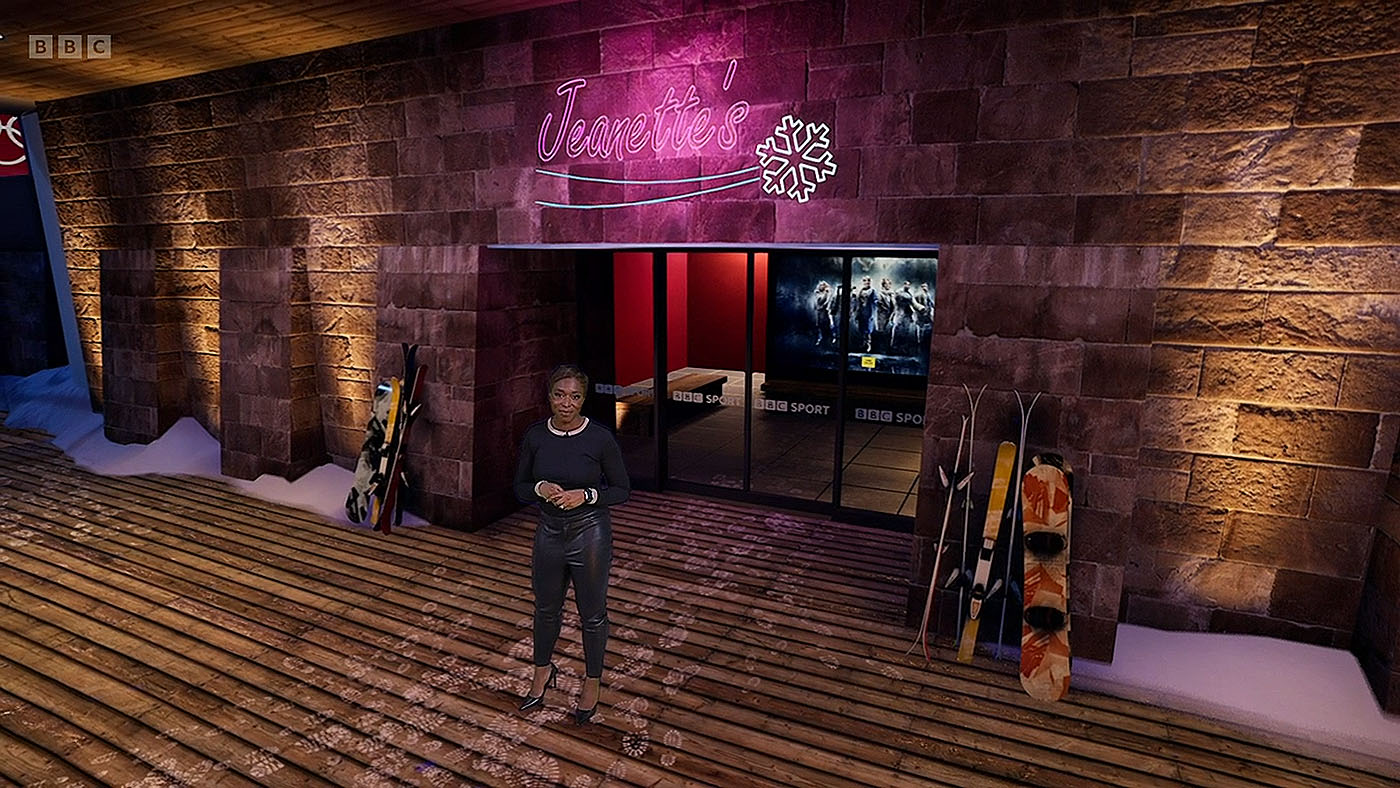
One of the most striking aspects of the project was how the virtual environment grew across the duration of the games. The deck areas of the ski resort design were conceived from the outset as flexible presentation spaces - and as the BBC's teams became more confident with the technology, new positions were added. By the closing ceremony, eight distinct presenting positions were in use, all shot within the same modest physical studio. Each position offered a genuinely different spatial and visual context - a different part of the resort, a different relationship to the landscape and sky.
A bar entrance was incorporated into the design, above which a neon sign could be switched to display the name of the current on-screen presenter - a characterful detail that added warmth and personality to the environment.
Mirroring Beijing from Salford
The virtual set mirrored the time of day in Beijing through three distinct lighting and sky configurations - day, dusk, and night - keeping the studio in visual synchrony with the live action taking place on the other side of the world. For a broadcaster covering over 300 hours of live content across BBC One, BBC Two, and BBC iPlayer, this temporal flexibility was editorially significant.
Technical Delivery
The studio ran on Vizrt's Viz Engine 4 integrated with Unreal Engine 4, using the Viz Fusion Keyer for greenscreen compositing and Mo-Sys StarTracker for camera tracking across five cameras - three pedestals, a jib/crane mounted camera, and a fifth locked-off ceiling camera added specifically for the Winter Olympics to provide a wider overhead perspective. The Viz Arc control application managed both render pipelines simultaneously, giving operators a single interface for a genuinely complex hybrid system.
John Murphy, Creative Director and Head of Graphics at BBC Sport, described the foundation that made it possible: "Prior to the summer, we converted a small studio space at Media City into a green screen area with a virtual design by Jim Mann and Toby Kalitowski, and enhanced rendering technology to deliver an immersive, enhanced experience for audiences. The studio, with five different presenting positions that can house a variety of sports output, will be a key presentation location for BBC Sport this year, including the Winter Games for which we have added more design and development."
The Result
A virtual environment that transported BBC Sport's presenters and audiences to a mountain ski resort — built from nothing, in a small greenscreen room in Salford, using imagination, architecture, and real-time technology in equal measure. It was, as Bramley concluded, "clearly virtual and we're not trying to pretend it's actually real, but it does look pretty impressive." The project also demonstrated something important: that a well-designed permanent studio, built with future events in mind, could be evolved and expanded for each successive production — a lasting asset rather than a single-event installation.
The NewscastStudio Broadcast Exchange interview with Jim Mann and Toby Kalitowski, discussing the design and development in detail, is available here.
Client
BBC Sport
Design
Jim Mann, Lightwell
Toby Kalitowski
Realtime Engine
Unreal Engine 4.26
Studio Integration
BBC Sport in-house team
Powered by
Viz 4
Keying
Viz Fusion Keyer
Camera Tracking
Mo-Sys StarTracker
Awards
Olympic Golden Rings - Bronze, Best Innovation or Set Design